¶ Location
- The Batcave
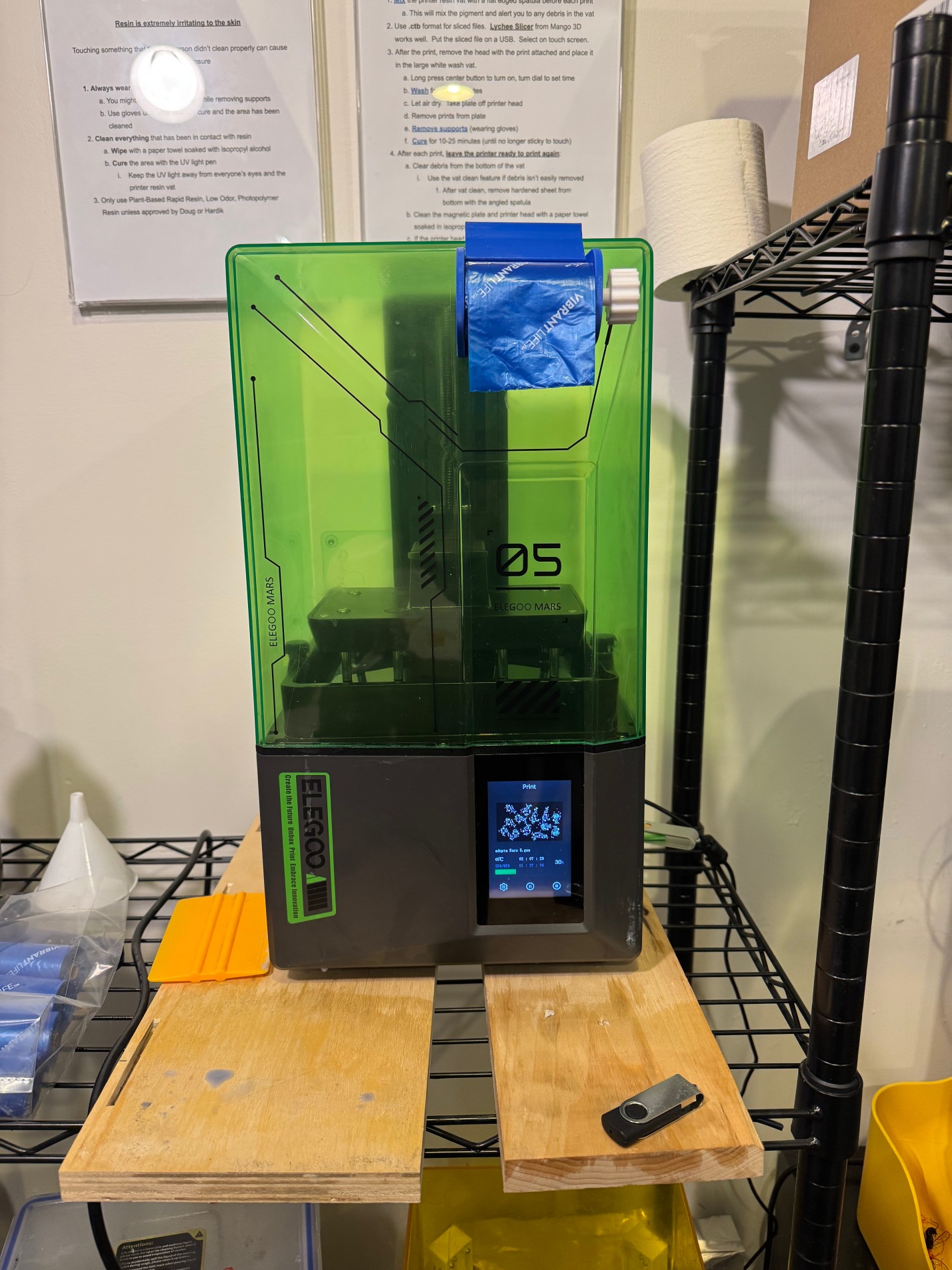
Elegoo Mars 5 — Resin 3D Printer
Wiki Equipment Entry · Makerspace
¶ Equipment Info
| Technology | MSLA (Masked Stereolithography) — UV-cured liquid resin |
| Resolution | 4K mono LCD, 6.6" screen, 4098 × 2560 px, 35 × 35 µm XY resolution |
| Build Volume | 143.43 × 89.6 × 150 mm |
| Layer Thickness | 0.01 – 0.3 mm (10 – 300 µm) |
| Print Speed | Up to 50 mm/hr |
| Light Source | COB (Chip-on-Board) UV LED, 405 nm wavelength |
| Connectivity | USB drive / Wi-Fi |
| Slicer Software | Chitubox (recommended) or Lychee Slicer |
| Auto Leveling | Yes — one-click, factory pre-leveled |
| Self-Check | Yes — pre-print self-diagnosis for component health |
¶ Station Equipment
- Elegoo Mars 5 printer
- IPA (isopropyl alcohol) wash bath
- UV curing station (405 nm)
- Drip tray — installed beneath the printer
- Funnel filters — for straining resin back into bottles
- Dedicated resin waste container (labeled)
¶ Supported Resin Types
The Mars 5 is compatible with most 405 nm photopolymer resins. Common types available at the space:
- Standard resin — general purpose, most affordable
- ABS-like resin — tougher and more impact-resistant
- Water-washable resin — cleaned with water instead of IPA; less flammable but still requires proper disposal
- Plant-based / eco resin — bio-sourced monomers; still emits VOCs and requires the same PPE
⚠ Always check the resin bottle's SDS (Safety Data Sheet) before using a new resin. SDS sheets for all space-approved resins are kept [TODO: location]. Do not use resins not approved by Logan.
¶ Safety
Uncured liquid resin is a skin and eye irritant, a sensitizer with repeated exposure, and harmful to aquatic ecosystems. IPA is highly flammable. All work involving resin — printing, washing, and curing — must follow the rules below.
¶ Required PPE
Wear ALL of the following whenever you touch resin, prints, the wash bath, or resin-contaminated tools:
- Nitrile gloves (minimum 5 mil thick) — NOT latex; latex degrades with resin
- Change immediately if gloves get resin on them — do not reuse disposable gloves
- Consider double-gloving during vat cleaning
- Safety glasses or chemical splash goggles (ANSI Z87.1 rated)
- Resin splash to the eye is a medical emergency — standard reading glasses are not sufficient
- Respirator with organic vapor filters (3M 6000/7500 series or equivalent) — required for vat cleaning, resin mixing, and any work in low-airflow spaces
- Apron or lab coat recommended — resin stains are extremely difficult to remove from fabric
¶ Ventilation
- All resin work must be done at the designated resin station with local ventilation running
- Resin emits VOCs (volatile organic compounds) that accumulate indoors — do not print in sealed spaces
- [TODO: Confirm if the Mars Mate air purifier or other ventilation is installed at this station]
¶ Resin Skin/Eye Contact
- Skin contact: Wash immediately and thoroughly with soap and water. Do NOT use IPA or alcohol — it spreads resin further into skin
- Eye contact: Flush immediately with water for 15+ minutes at the eyewash station. Seek medical attention
- Sensitization risk: Repeated skin exposure to uncured resin can cause a permanent allergic reaction over time — gloves are non-optional
¶ Fire Safety
- IPA is highly flammable — keep it away from open flames and heat sources
- Never heat IPA in any kind of ultrasonic cleaner; vapor can ignite
- A Class B (or ABC) fire extinguisher is located at [TODO: location near resin station]
- Keep IPA containers capped when not in use
¶ Operating Procedure
¶ Before You Print
- Put on PPE (gloves + safety glasses minimum, respirator if in doubt)
- Confirm the resin vat is clean and properly seated
- Shake resin bottle for 30–60 seconds before pouring
- Pour resin slowly into the vat — do not exceed the MAX fill line
- Use the on-screen self-check (one tap) to verify component status before each print
- Load your .ctb file via USB drive or Wi-Fi and confirm settings in Chitubox
¶ During Printing
- Do not open the cover mid-print unless absolutely necessary — UV exposure can partially cure the vat
- The printer has a built-in camera for remote monitoring — use it if available to check on prints without being present
- Smart sensors will alarm for: resin shortage, leveling failure, residue detected on screen, and overheating (>80°C)
- Power-loss resume is supported — if printing is interrupted, the printer will ask to resume from the last layer
¶ Post-Processing: Wash
Fresh prints are coated in liquid, uncured resin — they are toxic and must not be touched with bare hands.
- Remove the build plate using the quick-release lever — hold it over the vat briefly to let resin drip back
- Use the plastic scraper to remove the print from the build plate — do this gently
- Place the print in the IPA wash bath — run the wash cycle per the station instructions (typically 3–5 min)
- Remove and allow the print to fully dry — IPA on the surface will interfere with curing
- A two-stage wash is recommended for best results: dirty bath first, then a clean bath
¶ Post-Processing: Cure
- Place dry print in the UV curing station — curing station uses 405 nm UV LEDs, matching the resin's cure wavelength
- Run for the recommended cure time (typically 2–5 min; check resin manufacturer's spec)
- Fully cured print: firm, non-tacky, no flex under light pressure — if still soft, cure again
- Once cured, the print is safe to handle with bare hands
¶ After Your Session — Cleanup
- Pour unused resin from the vat back into the bottle using the dual pour spouts and a funnel filter — do not leave resin sitting in the vat long-term
- Wipe down the vat and build plate with IPA on a paper towel — dispose of paper towels in the dedicated resin waste bin (not general trash)
- Wipe down the work surface with IPA
- All resin-contaminated paper towels, gloves, and materials must be cured before disposal (see Waste Disposal below)
¶ Waste Disposal
⚠ NEVER pour liquid resin, resin-contaminated IPA, or resin-soaked materials down a drain. Resin is toxic to aquatic life and is illegal to discharge in most jurisdictions.
¶ Cured Solid Waste (safe for trash)
- Fully cured prints, failed prints, and support structures — can go in regular trash once completely solid and non-tacky
- Resin-soaked paper towels, wipes, or gloves — must be cured first: spread them out and expose to the UV curing station or direct sunlight until hardened, then trash
¶ Liquid Resin Waste
- Unused resin goes back in the original bottle
- Small amounts of uncured resin residue: spread in a thin layer and cure under the UV station or in direct sunlight until fully hardened, then trash
- Larger volumes of waste resin: collect in the labeled waste container at the station — do not dispose of at home. [TODO: confirm hazardous waste pickup schedule]
¶ IPA / Wash Solution
- IPA darkens and becomes cloudy as it accumulates dissolved resin — replace when it no longer produces clean results (approximately every 30 prints, or when visibly amber/grey)
- To recycle dirty IPA: pour into a clear, open container and leave in direct sunlight — IPA evaporates and UV light cures the suspended resin into solid particles. Filter and reuse the remaining IPA
- Solidified resin sludge from IPA recovery: treat as cured solid waste — trash once fully hardened
- IPA that cannot be recycled: collect in labeled container for hazardous waste disposal. Do NOT pour down the drain
¶ Maintenance
¶ Member Responsibilities (After Every Session)
- Return unused resin to bottle — do not leave resin in the vat
- Wipe down build plate and vat
- Clean work surface; dispose of waste materials properly
- Check that the drip tray is empty and clean
- Report any issues to Logan Brown or the general 3D printing channel
¶ Regular Maintenance (Logan / Leads)
- FEP release film: inspect for scratches, cloudiness, or punctures. Replace when print quality degrades or damage is visible. The printer tracks film usage — check via the self-test screen
- LCD screen: inspect for damage or resin contamination below the FEP film. Run residue detection via the self-check before each session
- Build plate: clean and inspect the laser-engraved surface for wear or damage
- Resin vat lock screws: inspect and replace if stripped or clogged
- IPA wash bath: drain and refresh as needed
- Drip tray: empty and clean regularly
¶ Firmware & Software Updates
- Firmware updates can be loaded manually via USB from Elegoo's official website — do not connect to untrusted networks
- Chitubox slicer configuration for the Mars 5 is on the included USB drive — always use the correct printer profile
¶ Troubleshooting Common Issues
| Print not sticking to build plate | Check auto-leveling; increase bottom layer exposure time; clean build plate |
| Print stuck to FEP film | Lower exposure time; check FEP for damage; ensure resin is properly mixed |
| Printer alarm — resin shortage | Pause and refill the vat (do not exceed MAX line) |
| Printer alarm — residue detected | Inspect FEP film for cured resin particles; remove carefully with soft tool before continuing |
| Printer alarm — leveling failure | Run one-click auto-level from the home screen; re-seat build plate |
| Printer stops — overheating | Allow to cool; do not continue printing until alarm clears; check for blocked vents |
| Print surface tacky after curing | Increase cure time; ensure print is fully dry before curing; check UV station bulbs |
| Poor detail / soft features | Reduce exposure time; check resin brand compatibility; check FEP film clarity |
¶ Access Requirements
- Resin printing training session with Logan Brown is required before solo use
- Training covers: PPE use, resin handling, printer operation, wash/cure workflow, and waste disposal
- Training sign-off is logged at [TODO: location/link]
¶ Members With Access
- Hardik Patel — space-wide lead
- Logan Brown — 3D printing lead
- TODO — additional trained members
¶ Reference Material
- Elegoo Mars 5 product page: https://us.elegoo.com/products/mars-5-4k-6-6inch-monochrome-lcd-resin-3d-printer
- Chitubox slicer (download & profiles): https://www.chitubox.com
- Lychee Slicer (alternative): https://lychee.mango3d.io
- Elegoo firmware & resources: https://www.elegoo.com/pages/resource
- Resin SDS sheets: [TODO — add link or physical location]
- Wash and cure station manual: [TODO — specify which unit is installed]
- Hazardous waste disposal info: [TODO — local dropoff location/schedule]
Last updated: [TODO] · Maintained by Logan Brown · Questions? Contact Logan or Hardik